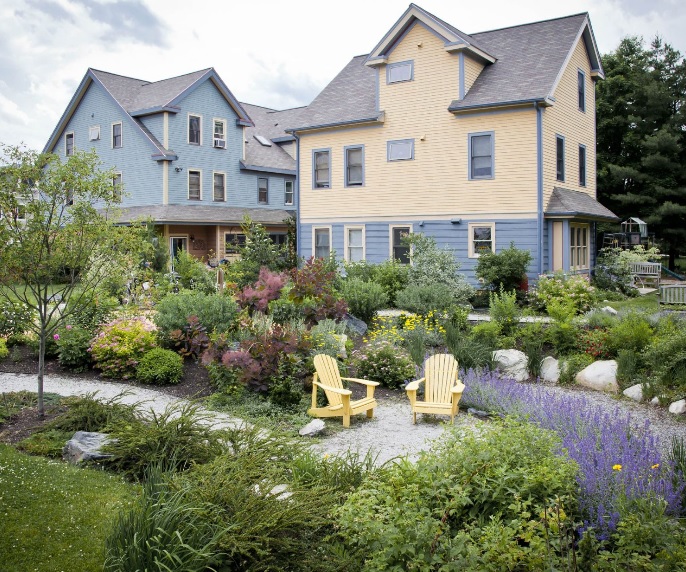
Tag Archives: cohousing

Example, urban: Cornerstone Village –Cambridge, MA

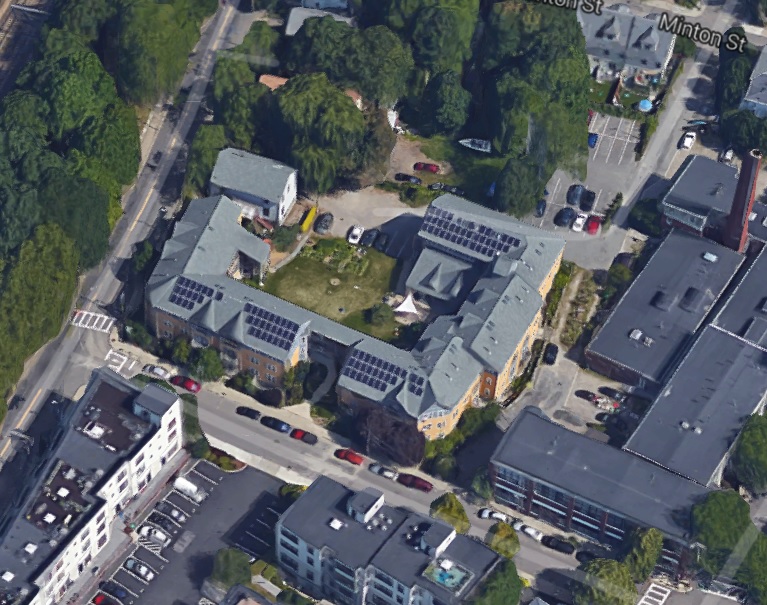
Cornerstone Village is located at 171-195 Harvey Street in North Cambridge,  a  dead-end street, close to where Fresh Pond Parkway meets Rt. 2  –near the Alewife MBTA station.

Their website, the articles written about the place, and diverse photographs of people living there, demonstrate a close-knit community of happy people.  Excepts follow.

http://www.cornerstonecohousing.org/

ABOUT

Cornerstone Village Cohousing began in 1993 with a group of people to develop a cohousing community in the northwest inner suburbs of Boston, Massachusetts.

Our project in North Cambridge, MA, is composed of 32 private housing units — ranging from one-bedroom flats to townhouses — and common facilities.

We are committed to living as a community that promotes sensible sharing of personal, social, and natural resources, provides a safe and stimulating environment for the growth of children and adults, and fosters beneficial relationships with the surrounding community and the world at large.


HISTORY

During the summer of 1993, Elizabeth Locke asked Marc Daigle and John Adelberg of The Cohousing Center for assistance in starting a cohousing community in the northwest suburbs of Boston. The three of them sketched out a development plan for the community and began to seek other interested people and potential sites. By spring 1994 they had found a good potential site.


In December 2001 the first group of households moved into Cornerstone…

The year 2003 … we got more practice in living together. This allowed us to refine and improve our ways of doing things — an ongoing process of community evolution. The grounds around our buildings began to show the fruits of the previous year’s work…

Late 2003 and early 2004 saw a big baby boom. We welcomed five new babies in as many months, and it became a delightfully regular sight to see infants being passed from one eager “baby holder” to another during common meals.

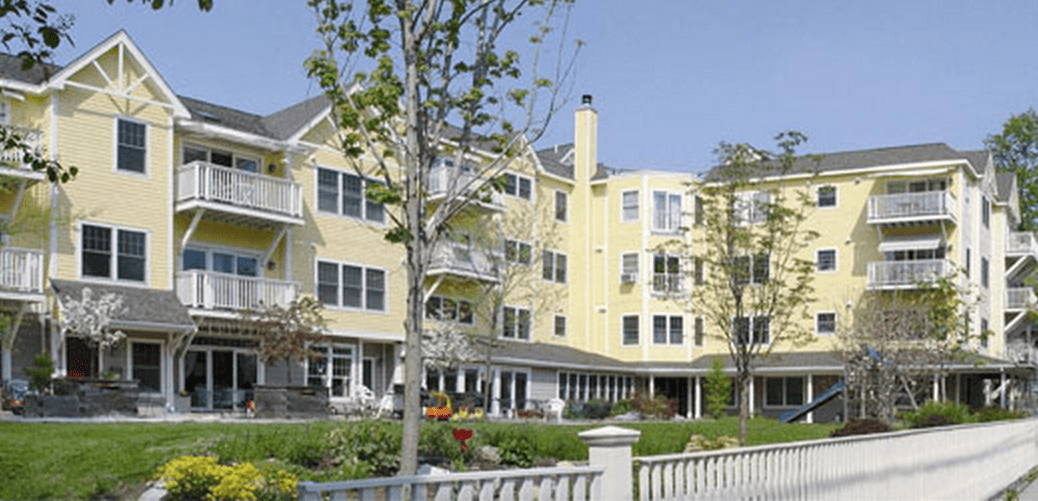
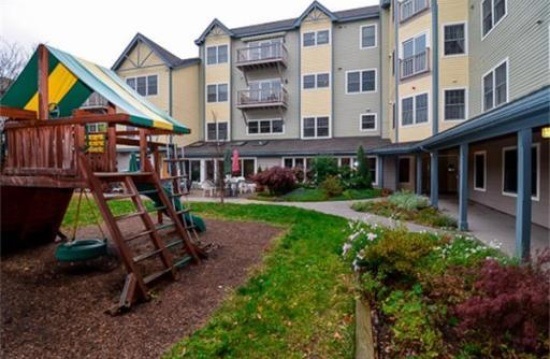
In late 2007 … we began to turn the open area in the center of our property from a parking lot and water retention pond into a gorgeously landscaped garden curving around and among a flat grass yard,… One of the first events in our new center yard in 2008 was a Sunday dance recital choreographed and performed  by some of the younger residents. Since then the yard has been a perfect place for the children who have outgrown our community playground.
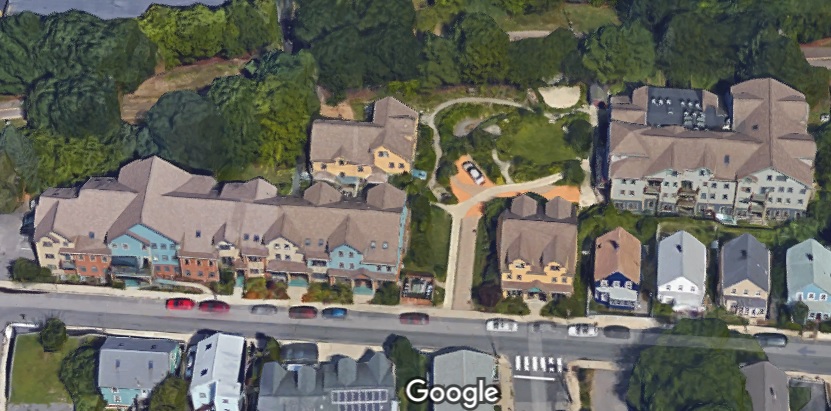
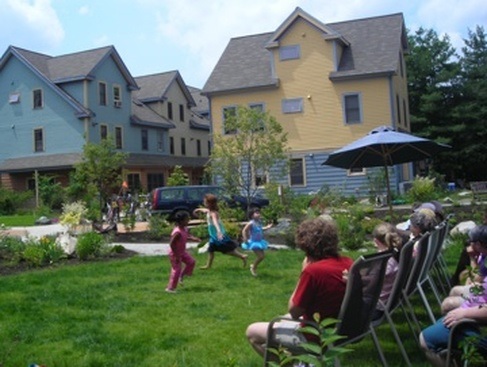
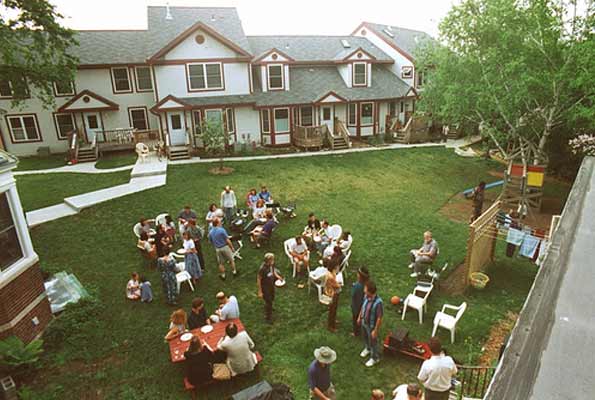
Cohousing --Cornerstone, Cambridge aerial 1 Cohousing --Cornerstone, Cambridge yard

=========================

from a website offering unit for sale:

http://soldonmls.com/default.asp?f=listing_details&listingid=429701&listingtype=2

Common areas include an arts and crafts room and separate playroom for children;

a large common room complete with a community kitchen and dining facility for all the residents.

There is a “quiet room” where one can read a book or organize a game or watch a movie.

There is also a wood working shop, guest room with bath that is available for residents to reserve, an exercise room, and bike storage area.

A large newly constructed room with a giant TV monitor serves as a meeting or social room.

The community has a number of celebrations and rituals that residents can choose to participate in, including a communal meal each Sunday, annual talent show, field day, spring Carnevale, Pysanky egg dyeing, music share, Halloween party, 4th of July BBQ, and many other planned and spontaneous gatherings.

Some families share childcare, others regularly attend concerts together, and children in the community will often find neighbors showing up for their school plays and sporting events.

=======================

FROM a recent article:

http://nowu.b12g.com/article/connect/sharing-responsibilities-joys-of-daily-living/17680497/index.html

Cohousing group brings generations together

Edward McClelland, NowU

OCTOBER 21, 2014

Elizabeth Locke, 68, the community’s “founding mother,” spent a decade sharing a two-apartment commune with a dozen friends…

She spent the next decade living in a single-family house, but neighbors came and went.

Then she read a newspaper article about cohousing, a type of community originating in Denmark that combines private space with common areas, such as dining rooms, lounges, gardens and libraries.

“I realized that I really wanted a community that could last through life changes,” Locke said. “People could move away and it wouldn’t fall apart. Also, the whole issue of community versus privacy was one for me. Cohousing seemed like a wonderful solution. You had the community, but you also had the space where you could go and close the door.”

Finding Acceptance

It was also a solution to the rootlessness felt by professionals who had moved to Boston for work, then had trouble finding acceptance in the city’s clannish neighborhoods. As Locke put it, her Cornerstone neighbors are “a little less than family and a little more than friends.”

Locke sought out residents through notices in newspapers and signs in public libraries. She organized dozens of recruitment meetings at local community centers and interviewed architects and contractors.

Once 15 people had committed, Cornerstone had enough funds to make a down payment on land and break ground in North Cambridge just outside Boston. By the time the development was completed, all the units had been sold…

A ‘Dream Team’ Offers Support

The close-knit community also has a “Dream Team” of doting neighbors who help residents going through difficult times. When Sue Donaldson’s partner, Julie, was diagnosed with a brain tumor, her Dream Team drove the couple to radiation treatments, fed their cat and delivered their groceries…

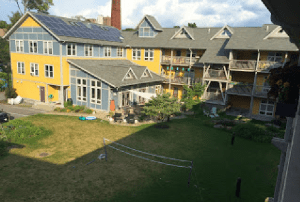
Example, urban –Jamaica Plain Cohousing

Jamaica Plain Cohousing is located in the Jamaica Plain neighborhood of Boston, south of the downtown area.
Close proximity to the MBTA Orange transit line makes this a convenient location.

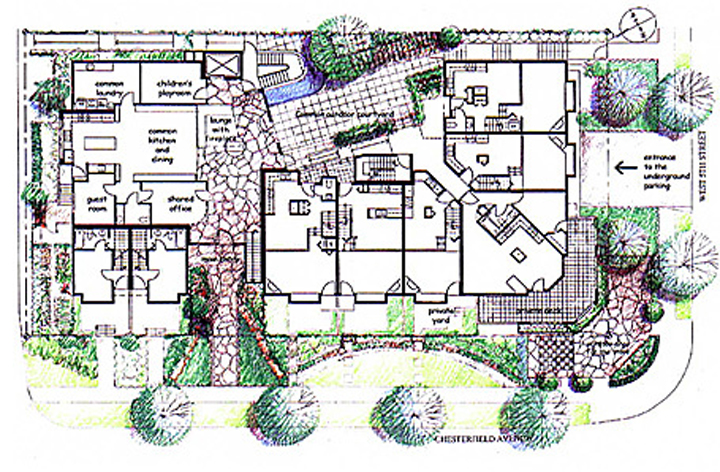
This is a good example of a small cohousing project in an urban setting. On 3/4 of an acre the architects succeeded in placing 30 flats and townhouse, plus a commons room, all surrounding a courtyard, for children to play in and adults to relax in.
In style it modernizes the triple-decker apartments of Boston, that had front porches on each level. In concept and function, it is similar to European housing built around a courtyard.

Kraus-Fitch Architects, Inc. did the programming and preliminary design of the site, common house and units, as well as consulting and review for the common house design development. Full services were done by Domenech, Hicks and Krockmalnic of Boston.

The schematic birds-eye plan was made by Kraus-Fitch Architects, Inc. More photos of the completed housing can be seen at their website:
http://www.krausfitch.com/project/jamaica-plain-cohousing
======================================
PHOTOS FROM OTHER SITES:

Google Images:

Jamaica Plain Cohousing common space
Courtyard seen from 3rd floor balcony.
Cohousing -Jamaica Plain commons
Commons space and part of courtyard. The roof now has solar panels. Photo compliments of Kraus Fitch Architects.

Google Maps:
Cohousing -Jamaica Plain aerial TILT

Example urban — Cambridge Cohousing, Cambridge MA

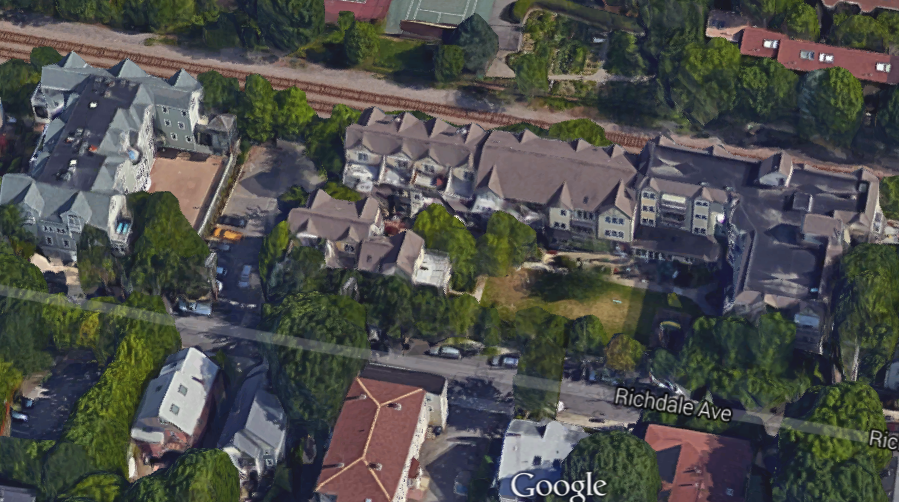
Cambridge Cohousing is located at 175 Richdale Ave. in Cambridge MA, halfway between Porter Square and Fresh Pond shopping plaza.

The architects have achieved a very peasant look, fitting 41 units on a tiny piece of land: 1.5 acre.  It helps that much of the parking is underground.  Less pleasant:  the homes on the north edge overlook the commuter rail from the west suburbs into Boston.  But that can be an asset: some trains stop at Porter Square. 
Aerial view from Google, tilted. Rail line is at top, in back of buildings.
Aerial view from Google, tilted.    Rail line is at top, in back of buildings.

Residents seem very happy to be living here, based on their comments and given that only 10 people have moved out, since 1998, when 90 first moved in.

 
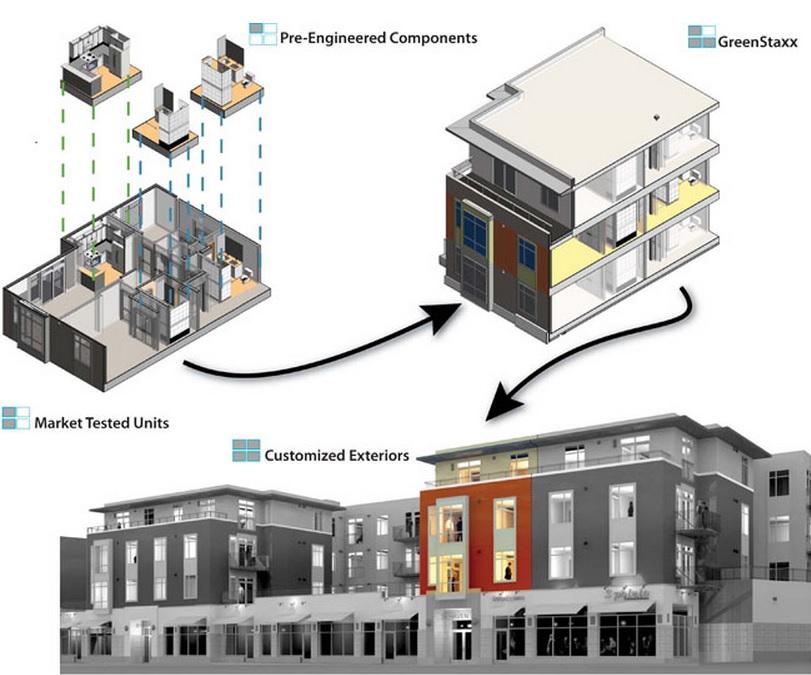
Construction was done by using modular units, which were stacked up, much like Legos.  The developer has posted a website showing the method, which is fascinating to read    (see link, far down below) .
 
In the next few sections, you will find excerpts from their website and others.  Most of the photos were found on Google.
=====================================

FROM:  http://www.cambridgecohousing.org/

Cambridge Cohousing is a community-designed and -developed housing project in Cambridge, MA. We are a group of people of diverse ages, backgrounds, abilities, professions and lifestyles. We are committed to creating a neighborly and cooperative community in which we know and care about one another. Children can play safely, surrounded by neighbors, and residents know that caring friends are close by. We are committed to the vitality, convenience and diversity that is Cambridge. To learn more about our goals, please read our vision statement.

Our dream has become reality on a quiet, tree-shaded 1.5 acre site, a 10 minute walk from Porter Square. The site faces south, and is close to schools, parks, shopping and public transportation.

If you’re in the Cambridge area, schedule a tour of the property. We also recommend that you become a Friend of Cambridge Cohousing. Membership is free and has several important perks, including priority e-mail notification of unit sales and rentals.

Recently, two community members, Molly and Dan Lynn Watt, sent out a holiday note that describes their lives at Cambridge Cohousing.

Holiday Season 2008-9

… We have a cozy apartment for solitude, common space for friendship, and life in Cambridge (including teaching, learning, writing, ushering, campaigning, consulting, dancing and singing, etc.) connecting us to the larger society.  …here’s our update on life in “coho.” In a nutshell, it’s good!

In 1996 we joined some pragmatic idealists meeting at Cambridge Friends Meeting to plan a cohousing community—making all decisions by consensus. We were planning a village within Cambridge where we would put as many values as possible into practice.

Our ages ran the gamut from newborn to 80, one third were single people, one third were groups of two or more (our category), one third were families with young children (27 kids under 15). Individual homes… are different styles and sizes, 1-room efficiencies to 4-bedroom townhouses. … 

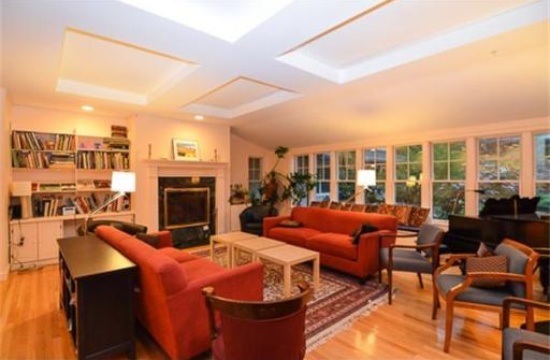
We enjoy using the many community spaces: a large living room with fireplace, kitchen and dining room with 2 children’s playrooms adjoining, plus a library, workshop, and rooms for exercise, recreation, laundry, music, bike storage, and 2 guest rooms.

Cambridge Cohousing --commons room

Underground parking, allows … a large “pretty good lawn,” a few smaller lawns, a shade garden, an open area we call “the glade,” several compost piles and a large organic garden.

We have planted many trees, shrubs and flowers and share the usual tasks. Unlike living in a single-family house, we can choose to specialize. Our responsibility— the shade garden, others shoveled the snow! The blessing of interdependence!

We hold an annual meeting to assess how we are doing on our sustainable living vision and how to do better as individuals and as a community. We use ground source heating and cooling … 

Our community has aged, we are almost 11 years older. More of our 83 residents are retired, three founding members died, several youngsters grew up and moved away, six are at college. We now have only 17 residents under 17 years. …Ten of our founding households have moved on, new committed residents have moved in.

We’re eating more locally —from the coho garden, farmers markets, and a weekly box from a community-supported farm in western Massachusetts. We are a drop-off point for 67 farm shares. Three times a week we may sign up for community meals (costs based on the shopping receipts range from $2.50 to $5.00 per person, kids —half price.) … 

Coho supports the wider community and world in other ways. The Fireside Reading series, curated by Molly, is now in its tenth year of readings. We host concerts of classical, folk and doo-wop; fundraisers for social justice organizations; support the Hospitality Program for Children’s Hospital; and we helped get a block party going on Richdale Avenue! … 

 We’ve gotten used to an aesthetic of small, densely organized living spaces. We know all our neighbors, and love participating with them to solve problems and get work done. … 

We are quietly content, wouldn’t want to live any other way, and never expect to move! We will join our community’s Carol sing, Hanukah party, Christmas tree trimming, solstice celebration and New Year’s Eve gathering in front of the fire, happy to be in a community able to enjoy as many celebrations as people will step up to lead! …

======================================

PHOTOS from other sites:

“Greenstaxx-system” was used at Cambridge Cohousing, by Oaktree Development LLC

FROM: http://www.oakdev.com/greenstaxx.php

This
This “Greenstaxx-system” was used at Cambridge Cohousing, by Oaktree Development LLC –a design-build firm.        Building shown is actually at 30 Haven, Reading MA — 53 homes over 22,000 sq.ft. commercial space

—————————————

Play area at Cambridge Cohousing

Cambridge Cohousing --play lawn

Example, urban — Quayside Village, North Vancouver, BC

This post  –and others after this– will show examples of cohousing that has been built in cities.

These urban examples are more relevant for what we could do in Providence:  they squeeze 15 – 70 condo units onto a land parcel of  limited size, and still try to optimize public spaces — and try to make everything look good.

  • If you like an example, please post your vote –in the comments section below the post.
  • If you dislike it, if you would not want to live in a place like this, please vote NAY.

In either case, it would help us if you could add a few comments about what you liked or disliked.

Thanks.

=======================================

So, let’s start with an example built in 1998 in North Vancouver, BC, Canada.

The pictures and descriptions were found at various websites.  Credit and links are given, whenever possible.

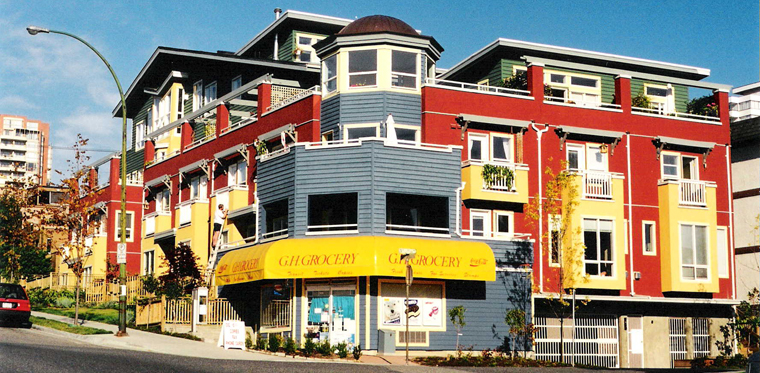
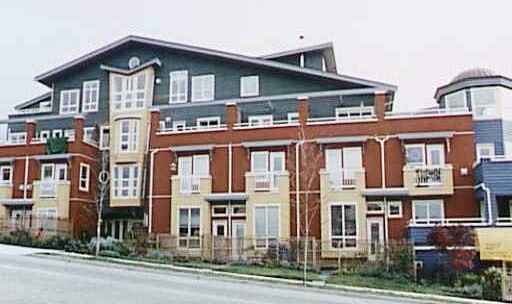
First,  the photo at the top of this post was taken by Marylee Stephenson and was originally posted by Kathy McGrenera at:  http://heartoncollective.com/stories/community/love-thy-neighbour-a-look-at-cohousing/

=======================================

FROM: http://www.cohousingconsulting.ca/proj%20Qv.html

Quayside Village  Project Description:

Located in the Lower Lonsdale area of North Vancouver, within walking distance of the public market, seabus to downtown Vancouver, restaurants, parks, schools, and other services.

The community is comprised of

  • 19 residential units,
  • a 2500 sq. ft. Common House and
  • a 650 sq. ft. commercial space.

The units are of mixed sizes and types with bachelor, 1 and 2 bedroom flats, as well as 2 and 3 bedroom townhouse units.

There are four homes that were sold that qualify as affordable as defined by BC Housing …

… one [affordable] rental unit  was retained by the [cohousing] community. 

There were certain requirements to qualify to purchase or rent these units. The rental home was built as a Universally Accessible unit and all common areas are wheel chair accessible.

The site is very compact at less than 1/4 of an acre. Townhouses with ground level entries serve the needs of the families with children. A common courtyard connecting to the common house provides child friendly play areas in this dense urban community.

 Apartment style homes on the upper floors have spectacular views of the mountains, Burrard Inlet and downtown Vancouver.

The common areas includes a rooftop deck and meditation room on the third floor, providing all residents with access to the inspiring views. On the ground level are the community gardens, a small courtyard, and a commons space with kitchen, dinning room, children’s playroom, guest apartment, laundry, craft room,  and office.

Quayside ground floor layout:

first floor at Quayside Village Cohousing

=======================================

FROM:  https://sites.google.com/site/quaysidevillage/home

     This is the official website for Quayside Village.

… The Urban Courtyard at Quayside Village is an inner crossroads. This is a place where neighbours meet, stop for a chat or greet one another in passing. The design incorporates a water feature and trellised vines that reach to the fourth floor, the top story. The intent of the design throughout the project is child friendly.

… On the third level in the southwest corner there is a large deck and an octagonal reading room with a 270-degree city, water and mountain view…

Contact us through our email:  quaysidevillage@gmail.com

=======================================

FROM:  http://connectcohousingcommunity.com/2014/03/23/live-is-better-living-together-a-glimpse-quayside-village-cohousing/

 …Quayside Village is a community consisting of 14 independent units, from a two story townhouse like dwelling to single bedroom units which from outside looked like any condominium building. But nearly all unit doors opened facing one another and the communal courtyard (full of flower beds, a gardener’s delight!)

Cohousing-Quayside-Village-connectcohousiing.files.wordpress.com-2014-01-quayside-court-yard

https://connectcohousiing.files.wordpress.com/2014/01/quayside-court-yard.png

   The Village has … a basement car park and a recycling room. The dining room becomes a communal entertainment center whenever a movie is shown for the benefit of all interested. All this while one could have one’s unit to go to enjoy privacy and cosiness of one’s own home. …

   The group activities, including gardening, communal cooking / and cleaning afterwards have interested families or a couple of individuals who organise and manage the events, something that makes residents more engaged if they liked to.

   In fact engagement in the activities of the Quayside Village was one of the initial requirements for the founders and the whole process of creating the village. Because all cohousing endeavours begin with a few people who have to collaborate and have inputs at all levels of the enterprise’s stages, finding like minded people, finding locations, dealing with many different ways of financing, the architects and developers and so on.

Grocery store at basement level is part of the project. Notice entry to parking garage at bottom right.
Grocery store at basement level is part of the project. Notice entry to parking garage at bottom right.

=======================================

A very insightful and heartwarming story was written recently by Kathy McGrenera.

This story describes how the project started, what life is like for one mother and her daughter, who grew up here.

It is posted at http://heartoncollective.com/stories/community/love-thy-neighbour-a-look-at-cohousing/

Below are some excerpts from her article  (I added the bold emphasis):

“In 1996 I joined three women who were determined to start a cohousing project in North Vancouver. Now, nearly 20 years later, it remains one of the best decisions of my life.

   At the time, those three wise women were in their 60s. I was approaching 40 and wanting to have a baby as a single woman. I knew I would need “a village to raise a child”, and cohousing, with its community-focused approach, sounded like an ideal scenario

….

   I have now been living happily at Quayside Village Cohousing with my 16-year-old daughter since she was born. Raising a child in cohousing has been a wonderful experience. My daughter, as an only child, has had the opportunity to develop sibling-like relationships with other kids in the building. She has also been blessed to have many caring adults in her life who act as different role models. Sadly, I think this opportunity is often missing in our isolated nuclear family model of living.

   In a world where parents often feel they need to be aware of their child’s safety at all times, my daughter has wandered freely all over our community since the age of three. To make sure I knew where she was, or could find her easily, I taught her to leave her shoes outside the door of whatever home she was visiting.

   Meanwhile, to ensure housing affordability, early on, and in collaboration with the City of North Vancouver, we decided to offer one affordable rental unit in the community and four below market units that sell in perpetuity at 20 per cent below market value. By doing so, we ensure the opportunity to live in cohousing remains accessible, regardless of income.

   Despite all of its benefits, living in cohousing is not without challenges. … To deal with these conflicts, it is important that people remain conscious of the many benefits there are to living in close contact with our neighbours. When we can remember we share a community and many common interests, we have much more motivation to work through the difficulties.

   In many instances, the conflicts we face can be blessings in disguise. One of the people at Quayside I initially found the most difficult has now become one of my dearest friends. By discussing the challenges I was experiencing and attributing to her behaviour, I came to understand a new perspective. Through our on-going conversations and exchange of ideas, we have built a friendship and my world has become that much richer.

   Perhaps one of my favourite things about living in cohousing is the community meals, something many cohousing communities do. At Quayside, we host common dinners on Monday and Thursday evenings at 6:15 p.m. People take turns cooking or cleaning, working alone or in a team. Our meal cycle is eight weeks. This means I usually cook once every eight weeks and during this time, get 16 yummy dinners. Meals usually end up costing about $4 each and children always eat for free. …”

——————————————————-

Read the whole story (don’t miss it) at:

http://heartoncollective.com/stories/community/love-thy-neighbour-a-look-at-cohousing/

=======================================

 OTHER PHOTOS  (found on Google Images)

Cohousing-Quayside- slope side

The main entrance is below the down-pointing column of windows.  

Notice the octagonal reading room at top right.


Quayside Cohousing plan

IMHO, this plan is a mash-up of 2 plans.  Almost all of the first floor is shown, but at the right side someone super-imposed the plan of the roof deck (hiding the apartments  in this area on the 1st floor).


Example: Monterey Cohousing (near Minneapolis)

To see a good example of cohousing, visit Monterey Cohousing.
This is an inter-generational community located just outside of Minneapolis, MN.

Their website is concise, elegant & delightful.

They describe cohousing very well (bold emphasis added):

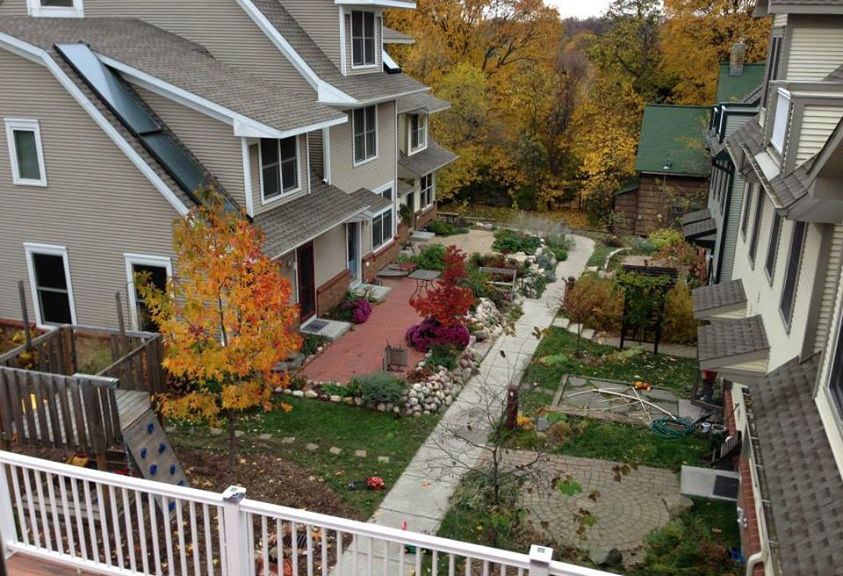
“Private homes contain all the features of conventional homes; residents also have access to extensive common facilities such as open space, courtyards, a playground, and a common house…

We help each other in ways large and small. Examples include sharing information and advice, lending and sharing skills and items of all kinds, and driving each other to appointments…

Cohousing provides the privacy we are accustomed to, within the community we seek.”

http://montereycohousing.com/about/

Example: Newberry Place Cohousing Community, Michigan

Newberry Place is a cohousing community in Grand Rapids, Michigan.

They have built a very well designed village, which looks upscale in quality.   It is basically a tight cluster of homes creating a courtyard effect, on a very small parcel.  Thus, it could be replicated on many a small, tight bit of land in most cities. And yet it looks cozy and almost suburban :–).

More at a very well designed Facebook page with many good photos:

https://www.facebook.com/NewberryPlace/timeline