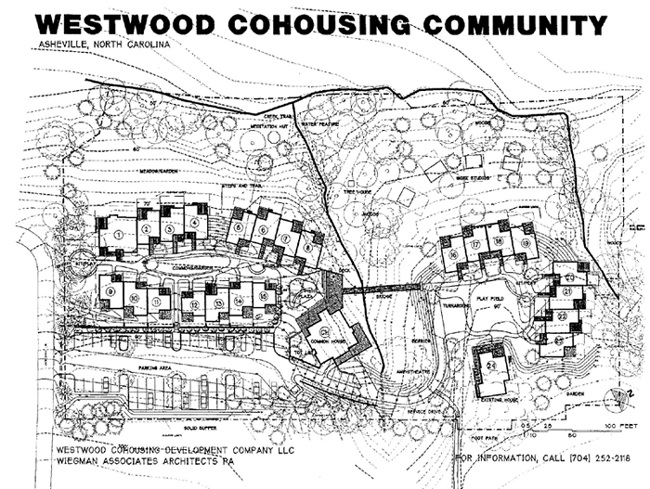
(Note: the diagram in the header is the original site plan for Westwood Cohousing in NC as presented on their website http://www.westwoodcohousing.com/details.html )
The steps to create a cohousing place can be learned by reading the stories of how some other places were created. A good summary was published by Westwood in West Asheville, North Carolina. First, what did they build?
Westwood is a cohousing community of 24 homes located near “downtown” West Asheville. Numerous shops and restaurants are within walking or biking distance. Two bus lines go into downtown Asheville, and driving access is convenient to the rest of the city and beyond. Our grounds feature gardens, landscaped commons, woods, a creek, and a bridge. The Common House has a kitchen and dining room, laundry facilities, a workshop, a library, and a den. Coin operated commercial washers and dryers are available in the Common House.
Next, they explain how they got started. The quote below is from their website at http://www.westwoodcohousing.com/details.html (I added the bold font):
History of Westwood CoHousing Community
Westwood CoHousing Community began when three circumstances converged.
- The site became available (1992).
- The idea [of cohousing] caught the imaginations of the owners of the Westwood property and others, and they saw the possibilities for a new community in Asheville.
- In fall of 1992 a core group formed around the Westwood site and plans started to take shape.
Early in 1994 it became clear that to build the community within the property owners’ time requirements, delineation of roles was needed, including that of a full-time developer.
- Not finding a suitable one in the area, the property owners (Lotte and Seymour Meyerson and their daughter Elana Kann), formed the Westwood Cohousing Development Company, with Elana as project manager.
- Bill Fleming, a member of the initial group, aided her as business consultant, and together they began to manage the business side of the community development.
- This included hiring professional design, legal and accounting staff.
In July 1994 the early members, the architects and their design team, and cohousing consultants devised a preliminary site plan.
Marketing of the project throughout the summer led to formation in August of a larger group called the Westwood Cohousing Future Homeowners Association, which began to meet weekly. In November 1994, through workshops offered by the Development Company, the Association members and the architects worked on site plan revisions and began to address the priorities for the buildings.
In May 1995 the workshops continued, now addressing the design programming for the common house and dwellings. At this point the Future Homeowners Association consisted of 12 future resident households. Over the next few months, the architects, with frequent review by the Association members, completed the basic floor plans. Estimated prices followed shortly. A marketing consultant worked with the Development Company and the Association for several months to help create effective marketing materials.
At public hearings in October, with several letters of support from neighbors, Westwood’s plans won unanimous approval and praise from Asheville’s Planning and Zoning Commission and the City Council.
In January 1996, details on basic dwelling units and an options list were ready. In February and March the members reserved their sites, units and options. Valuable plants were moved out of the way of the bulldozers.
By June 1996 the community had 20 full members and two associate members (future renters). The Assocation and Development Company made final budget and design decisions and the Development Company began to negotiate with lenders and builders in preparation for construction.
In October, the Development Company selected a general contractor, known coincidentally by the company name of Westwood Enterprises (no relation). After months of frustrating negotiations with several local banks to obtain a construction loan, the Development Company formed a private Construction Loan Pool, with fundraising help and loans from some Association members, and by early spring 1997 had raised enough money to begin building. The property owners transferred land ownership to the Development Company.
During this time, the Future Homeowners Association selected an interim Board of Directors, formed increasingly active work teams, and heightened its social community building among members. Members started hard physical work on the site which became known as Sweat Equity Work. They built a perimeter fence and continued transplanting special foliage. Several valuable trees were felled and milled professionally. Members stacked logs on the property for later use as benches and play equipment. All this despite the fact that half the members lived outside the area and could not participate fully. In April 1997 the members signed sales contracts with the Development Company and paid large earnest deposits on their dwellings.
Construction officially began in late April 1997. By the time the groundbreaking ceremony was held in May, all the units were reserved with deposits paid. In addition, there was a waiting list for purchase, and a list developed for people interested in renting from owners who were not ready to move to Asheville when their dwellings were completed.
Also in May, the Westwood CoHousing Homeowners Association was incorporated, ready to receive the deed for the Common Elements from the Development Company when 3/4 of the buyers moved in. The Association elected an Interim Board. Some members moved into Block A in December 1997. The builder finished other dwelling blocks in phases, all the while battling rain and mud during one of the wettest winters on record. The Common House was completed during that period.
By August 1998 all units were completed and occupied. The the fall of 1998 a new Board of Directors was elected to serve terms of various years. The Development Company, at the end of the one-year warranty period, went out of business in August 1999 as planned.
Members have completed the sweat equity projects and maintained the Common Elements, doing most of the work ourselves. In the process, we have been learning to govern ourselves. Shared meals and social occasions have served to build a sense of community.
————– end of quote ————–
By all means, please do visit their website: http://www.westwoodcohousing.com/
Then go to the bottom of the page and explore some of their links. They have delightful PICTURES. Then look at DETAILS where you will find:
What is Cohousing?: A brief description.
History of Westwood: How Westwood was created.
The site plan: Our original site plan.
The common house: Floor plans and an exterior view of the common house.
Sample Images of base plan: These images are reduced versions of several floor base plans.
Westwood’s Infrastructure: A more detailed look at the heat and hot water systems.
The North Carolina Green Building database: Westwood is in it! Many technical details.
Take a look at FOR SALE/RENT where you will find some units for sale, with many photos. When I looked Feb. 26, 2017 there were 2 units listed: a one bedroom unit for $225,000 and a 3 BR for $300,000.
The INFRASTRUCTURE article is also interesting. They have a shared heating system, meaning that the hot water is boiled in one big furnace in the common house and then is piped to all the units, where it radiates from the floors.
 Providence Cohousing
thank you for sending this. I think this is the group that Pat Gifford is associated with. Is that correct? Can you provide any other names of people working on this? many thanks Libby Edgerly 401-274-1597
LikeLike
VI3?????!!!!!! holy cow person… so what can i actually do that may help you update? HAHAHA Possessing thinking about this particular to verify if Stones really are staying sly Available you happen to be researching two different things. The site retains typically the T&C’s and under all of them typically the license arrangement. In case you compare the particular licenses commitment on websites on the one particular we have if we install the required forms it is the very same besides the numbering with the partitions usually are proper on websites. Often the T&C’s complete release the truth that this is a P2P primarily based. Sorry to say the item.
LikeLike